7 Everyday Challenges the Deaf Community Face

Signapse
For most people, everyday tasks such as going to the supermarket, ordering a drink at a coffee shop or phoning the GP are so routine that they barely require thought. But, for members of the Deaf community, these same activities can be filled with invisible barriers or moments of exclusion. The Deaf community is diverse: some rely on sign language, some on lip reading, some on hearing technology and many use a combination of methods. Yet across the country, Deaf people experience many of the same daily challenges in a world shaped around spoken communication.
These obstacles are often subtle and rarely noticed by hearing people. They arise from habit, systems and environments that unintentionally exclude Deaf individuals. Understanding these challenges helps us make everyday life more inclusive and respectful.
In this guide, we delve into seven everyday challenges Deaf people face and how small adjustments can ensure you are prioritising Deaf accessibility.
1. Communication Barriers in Public Spaces
Public spaces like coffee shops, supermarkets, high street banks and pharmacies are filled with quick, speech-based interactions. For Deaf individuals, these simple moments can become unexpectedly stressful.
Imagine trying to order a drink but the assistant never looks up, making lip reading impossible. Or visiting the pharmacy and facing impatience when you ask for information in writing. Even small actions, such as speaking while turning away, covering your mouth while talking or rushing, can disrupt communication completely.
Some Deaf people use notes, gestures or apps to bridge the gap, but these methods rely on a willingness from others to engage respectfully and patiently. Privacy can also be an issue when writing notes in banks or medical settings.
What can you do?: Maintain eye contact, offer to write things down or take a little extra time to communicate to make everyday interactions far more accessible.
2. Limited Access to Emergency Services
Accessing emergency services can be especially difficult. Traditional systems still rely heavily on voice calls, and although text-based services exist, their availability and reliability can vary by region.
Some places offer emergency video relay services or text-based solutions. For example, in the UK, Deaf individuals can use the 999 BSL app to make an emergency call through video relay. Alternatively, there is also Relay UK that provides another app-based service or Emergency SMS. The US also offers a similar system, Text-to-911.
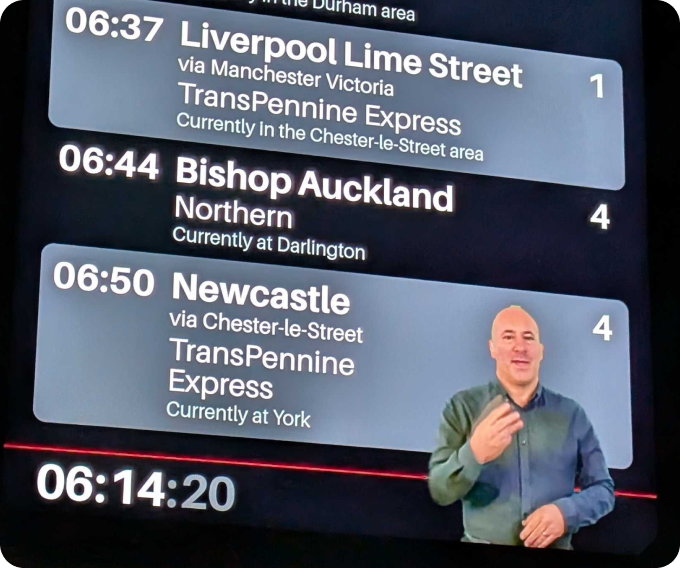
Visual alert systems are also inconsistent. Fire alarms without strobe lights, station announcements delivered solely over loudspeakers or emergency instructions given verbally can leave Deaf individuals unaware of urgent developments around them.
What changes should be made?: Accessibility in emergencies is essential, not optional. Ensuring visual as well as audio alerts can save lives.
3. Exclusion in Social Settings
Social situations can be unintentionally isolating. Group conversations move quickly, people talk over each other, jokes are shared without context and background noise makes lip reading almost impossible in busy venues.
Even in smaller gatherings, people often forget to face the Deaf person, signal a topic change or summarise what’s been said. These aren’t deliberate acts of exclusion. They’re habits formed in a hearing-centered world. But the result can be the same: feeling left out of conversations.
Something as simple as turning to face someone before speaking, taking turns or ensuring they’re included before the conversation moves on can make a huge difference.
What can you do?: Be more conscious about your habits during conversations and ensure you are creating an inclusive conversation.
4. Workplace Barriers
Despite strong legal frameworks requiring reasonable adjustments, Deaf employees still experience barriers at work. Some examples include:
- Meetings without interpreters
- Training videos or webinars without accurate captions
- Phone-based systems for booking shifts or appointments
- Colleagues speaking while turned away or covering their mouths
- Assumptions that Deaf team members cannot handle customer-facing roles
Misunderstandings about who arranges or pays for adjustments can cause delays, even though support services widely available. Plus, “adjustments” are often minor. For example, captioning, interpreter support, communication training. However, they can make a major difference in ensuring equal participation.
In the UK, as per the Equality Act 2010, it is up to workplaces to ensure their working environment is accessible for all their employees and customers. In the US, workplaces often following captioning and interpreter standards under federal law, but consistency varies across the country.
Why should organisations prioritise accessibility for the Deaf?: Workplaces that embrace Deaf awareness are more effective, collaborative and inclusive.
5. Inaccessible Media and Digital Content
As more content moves online, accessibility has improved, but not evenly. There are still glaring issues that are leaving a community behind. Some common issues include:
- Videos without captions
- Auto-captions that miss key information
- Livestreams without interpreters
- Educational content or tutorials without transcripts
- Government or public announcements that rely entirely on audio
Some countries introduced accessibility standards for digital media. For example, the WCAG (Web Content Accessibility Guidelines) is a global standard that many countries, including the UK and US, have adopted into their own laws. In most cases, a Level AA conformance is a recommended starting point for accessibility standards. This means adding accessibility features such as captions in pre-recorded and live media.
For Deaf audiences, however, captions are not always suitable. To achieve Level AAA, the highest level of conformance, sign language interpretation should be provided.
What can organisations do?: Adding subtitles is a start but ultimately, sign language translation in digital content is best.
6. Healthcare Communication Gaps
Healthcare is one of the most critical areas where clear communication matters, yet it’s also where many Deaf people encounter serious challenges. These can include:
- Surgeries and clinics insisting on telephone-only booking
- Doctors speaking while facing a screen
- Masks preventing lip reading
- Interpreters not being booked, arriving late or being refused
- Staff lacking basic Deaf awareness
- Misunderstandings during remote or rushed appointments
- Longer wait times due to no available interpreters
National communication standards exist to ensure accessible information, but implementation varies significantly. In practice, some providers excel at inclusive care while others fall short. In other parts of the world, hospitals are required to provide interpreters under disability law, but practical access still depends on training, resources and awareness.
Accessibility is not something that we can take for granted in healthcare. Especially in times of emergency or when urgent diagnosis is required, waiting for an interpreter can be the difference between life and death.
How can healthcare change?: Healthcare should never rely on guesswork. Interpreters, visual aids and accessible communication are essential and must be present at all times.
7. Daily Microaggressions and Misconceptions
Not all challenges are structural. Many are small, everyday behaviours that stem from misunderstandings about Deafness. For example:
- People shouting unnecessarily
- “Nevermind, it doesn’t matter,” when asked to repeat something
- Assuming Deaf means unable to work, drive or parent
- Treating Deaf adults as though they need constant assistance
- Asking intrusive questions about hearing aids or implants
- Assuming sign language is universal or “just gestures”
- Using outdated terms such as “deaf and dumb” or “hearing impaired”
These microaggressions aren’t always intentional, but their impact is real. They contribute to stereotypes and can make interactions feel demeaning or exhausting.
What can you do?: Respectful communication, without assumptions, helps build genuine inclusion.
How Modern Technology Can Change Lives
Technology has brought incredible progress to once inaccessible spaces. From video relay services to captioning apps, vibrating alarms, visual doorbells and AI sign language translation technology, the number of accessibility technologies is only growing. But, technology alone cannot replace awareness, accessible systems or inclusive attitudes.
Change must start with understanding. Simply, implementing accessibility features into your content will prove to be ineffective. Educating yourself on Deaf culture and what you can do to make effective change is the best starting point!
What Signapse Are Doing to Make a Difference
Deaf individuals navigate countless challenges that hearing people rarely see. Most of these barriers aren’t created intentionally. They simply arise from systems and habits built for a hearing majority. The good news is that many of these challenges have simple solutions. Maintaining eye contact, offering sign language translation, booking interpreters and being patient can transform everyday experiences.
At Signapse, we are rewriting sign language translation technology. With our generative AI technology, we have created products that not only provide fast sign language translation, but also serves the community it is built for. Explore SignStudio and SignStream today to make your content accessible to a community often left behind.
Why not also book a demo with our team to experience our technology first hand?
Together, we can build an inclusive future where everyone benefits.
FAQs
What challenges do Deaf people face in society?
There are many aspects of everyday life that are inaccessible to the Deaf community. From coffee shops to supermarkets, bus stations, banks, pharmacies and more, each of these public spaces are built for hearing audiences making accessibility limited. This inaccessibility also bleeds into more sensitive public spaces such as healthcare, legal and educational settings.
Why isn’t lip reading or subtitles enough for clear communication?
Lip reading is extremely difficult, as many sounds look identical on the lips and context is often missing. Subtitles are also not always appropriate as, for most Deaf individuals, written language may not be their native language. Instead, sign language translations work best as they provide clear communication with context.
What simple things can hearing people do to be more inclusive?
Maintaining eye contact, speaking clearly and making sure someone can see your face can go a long way. Offering to write something down, using gestures and being patient help create a far more accessible environment in everyday life.
If you are a business owner, it is a good idea to review your accessibility features and make amends where needed to accommodate the Deaf community affectively. Why not try implementing sign language translation? You can try it for free with our SignStream Chat tool!
Related Articles
What is the Difference Between Diversity and Inclusion?
Making Your Videos Accessible: Translating Sign Language for a Broader Audience
Bridging the Communication Gap for Deaf Individuals at Work
.png)
.png)